


Costco vs Miracle-Ear vs Beltone vs an independent audiologist
Costco, Miracle-Ear, Beltone or an independent audiologist? Compare who fits you, return windows, warranties, follow-up care and what buyers paid.
- 21 sources cited
- Updated October 14, 2026
- 11 min read
Written by the DrAuditory editorial team from the 21 sources listed below. How we write guides · Last updated October 14, 2026
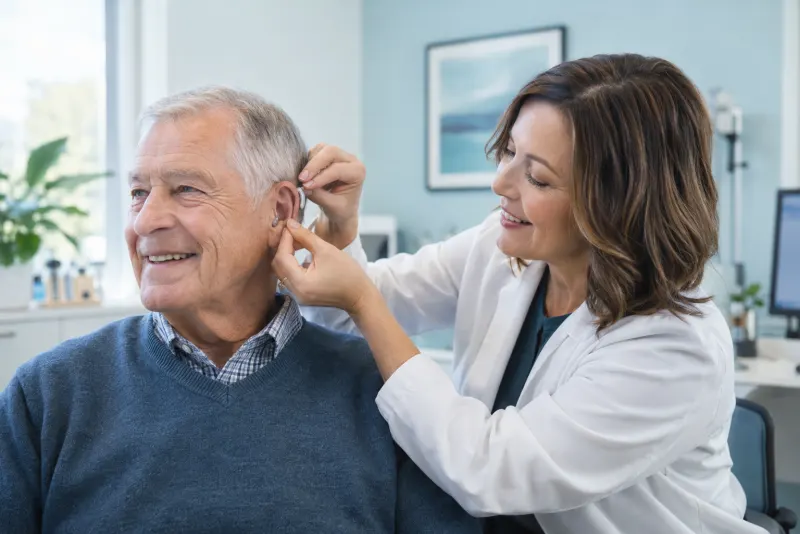
Costco suits members who want brand-name aids at lower listed prices and a 180-day return window. Miracle-Ear and Beltone suit people who want many locations and years of bundled cleanings and checkups. An independent audiologist suits people who want an audiologist doing the testing and fitting, which the federal registry shows far more often at independent practices.
Key takeaways
- In the federal NPI registry, 52% of independent practices have an audiologist registered at the address, compared with 12% of Beltone, 5% of Miracle-Ear and 2% of Costco locations. The registry is not a staffing audit.
- Costco lists a 180-day return policy. Miracle-Ear and Beltone publish 30-day return windows, and Miracle-Ear counts from the end of fitting.
- In a 2025 buyer survey, Costco pairs averaged $1,674, national chains such as Miracle-Ear and Beltone averaged $3,403, and local audiology practices averaged $3,601.
- GN, which makes Beltone hearing aids, agreed in March 2026 to sell its hearing business to Amplifon, Miracle-Ear's owner. GN expected the sale to close by the end of 2026.
- Whoever you choose, ask for real-ear measurement and get the trial, fees, warranty and included follow-up visits in writing.
Costco is usually the cheapest of the three chains and lists the longest return window. Miracle-Ear and Beltone bundle years of free cleanings and checkups but publish 30-day return windows. An independent practice is the most likely of the four to have an audiologist registered at the address.
In HearingTracker's 2025 survey of U.S. buyers, Costco pairs averaged $1,674, national chains such as Miracle-Ear and Beltone averaged $3,403, and local audiology practices averaged $3,601 [1]. In the federal NPI registry, 52% of independent practices have an audiologist registered at the address, compared with 12% of Beltone, 5% of Miracle-Ear and 2% of Costco locations [2].
Any of the four can fit hearing aids well if they test you fully, check the fit and stay with you through follow-up. This guide puts them side by side using each company's published terms and DrAuditory's own analysis of the registry.
DrAuditory isn't affiliated with Costco, Miracle-Ear, Beltone or any clinic, and earns nothing from them.
Costco vs Miracle-Ear vs Beltone vs independent practices at a glance
Location and staffing counts are DrAuditory's own analysis of the federal National Plan and Provider Enumeration System (NPPES), September 2026 release [2]. See how we build this directory for the method. Policies come from each company's own website as of October 2026.
| Costco Hearing Aid Center | Miracle-Ear | Beltone | Independent practices | |
|---|---|---|---|---|
| Locations in the registry | 185 in 40 states | 569 in 48 states | 217 in 40 states | 12,366 in 50 states and DC |
| Locations with an audiologist registered | 2% | 5% | 12% | 52% |
| Audiologists / hearing aid specialists registered | 5 / 10 | 26 / 546 | 29 / 233 | n/a |
| Who runs it | Costco Wholesale, inside its warehouses [3] | Amplifon, through company-run and franchised stores [4] | Independently owned centers; Beltone is a GN trademark [5] | Local owners |
| Hearing aids | Philips, Jabra, Rexton and Sonite [6] | Miracle-Ear brand; maker not named [7] | Beltone brand, made by GN [8] | Whatever the practice carries |
| Published return window | 180 days [9] | 30 days from the end of fitting; fitting fees may apply [10] | 30 days from receiving the aids; fees may reduce the refund [11] | Set by the practice; most states require at least 30 days [12] |
| Price | Pairs listed from $1,599.99, varying by state [6] | Quoted in store [13]; national chains averaged $3,403 [1] | National chains averaged $3,403 [1] | Local practices averaged $3,601 [1] |
| Follow-up care | Free service appointments for aids bought there [6] | Free lifetime aftercare, except with some insurance purchases [14] | Belcare annual checks and cleanings, private pay only [11] | Ask what visits are bundled |
| Warranty | Loss-and-damage warranty; terms not on its benefits page [9] | 3-year limited warranty on almost all aids [15] | 12 months of repair and of loss and damage cover, with a deductible [16] | Set by the maker and the practice |
What the registry shows, and what it doesn't. NPPES only shows providers who registered a National Provider Identifier (NPI) at that address. Hearing aid specialists who don't bill insurance often have no NPI, and warehouse-club staff are rarely linked to the store's NPI. So these numbers show what the federal registry shows, not a staffing audit. Ask any location who will test and fit you, and what their license is.
Costco, for example, says its licensed staff run free on-site hearing tests [3]. Audiologists need a doctor of audiology degree, and every state requires them to be licensed [17]. Hearing aid specialists are licensed by state or provincial authorities to test hearing and fit hearing aids, and the rules vary by state [18]. Either can do a good fitting, so ask what steps they follow.
What buyers paid
HearingTracker surveyed U.S. hearing aid owners in 2025 and analyzed 879 pair purchases with a reported price, leaving out aids from the VA [1]. Prices are self-reported, so treat them as a guide rather than exact market rates.
| Where people bought | Average per pair | Median per pair |
|---|---|---|
| Costco | $1,674 | $1,600 |
| National chains such as Miracle-Ear and Beltone | $3,403 | Not reported |
| Local audiology clinics and private practices | $3,601 | Not reported |
| Traditional clinic, using an insurance benefit | $2,567 | $2,000 |
| Traditional clinic, no insurance | $4,727 | $5,000 |
The survey also listed per-brand averages of $2,788 a pair for Miracle-Ear and $1,755 for Beltone [1]. Each figure rests on only 34 buyers who reported a price, and the brand table doesn't say how many used insurance. Don't read much into the gap between the two.
Who did the fitting also tracked with price. Private-pay buyers fitted by an audiologist reported a median of $4,200 a pair, versus $1,600 for private-pay buyers fitted by a hearing instrument specialist [1].
Costco posts its prices online [6]. Miracle-Ear's site says you get your personalized price in store [13].
What each option does well, and what you give up
Costco Hearing Aid Center
What it does well
- Lower listed prices. Costco lists pairs from $1,599.99, and prices vary by state [6].
- The longest return window of the three chains. Costco lists a 180-day return policy [9].
- Brand-name aids. The lineup includes Philips, Jabra, Rexton and Sonite models [6]. HearingTracker notes that Jabra and Rexton come from the same parent companies as ReSound and Signia, and that Philips aids are made under a Demant license [1].
- Free service. Members 18 and older get a free hearing test, and service appointments are free for aids bought there [6].
What you give up
- Membership. The free hearing test is for Costco members [6].
- Few audiologists on record. Only 2% of Costco locations have an audiologist registered, though the registry misses many warehouse staff [2].
- Unpublished warranty terms. Costco lists a loss-and-damage warranty but doesn't give its length or deductible on that page [9]. Ask for both in writing.
- A short brand list. Four brands are featured on its hearing aid page [6]. If you want a model from another maker, you'll need to shop elsewhere.
See every Costco hearing aid center in the directory.
Miracle-Ear
What it does well
- Reach. Miracle-Ear is part of Amplifon, a hearing care retailer based in Milan, Italy. Amplifon says the U.S. network had more than 420 company-run locations and about 1,200 franchised ones in April 2025 [4].
- Aftercare in the price. Miracle-Ear includes free lifetime aftercare, with quarterly cleanings and checks and a yearly hearing test, at any of its locations nationwide [14].
- A longer warranty. It advertises a 3-year limited warranty on almost all of its hearing aids [15].
- A free hearing test. Its terms say the test is always free and is not a medical exam [10].
What you give up
- No prices online. You get a price in store [13].
- A 30-day window that starts after fitting. Aids may be returned for a full refund within 30 days of the completion of fitting, in satisfactory condition, and fitting fees may apply [10].
- Insurance can change the deal. Lifetime aftercare isn't included with aids bought using some insurance benefits [14].
- Own-brand devices. Miracle-Ear sells Miracle-Ear-branded aids, and its product page doesn't name the maker [7]. That makes like-for-like price checks with other sellers harder.
- Few audiologists on record. 5% of locations have one registered, alongside 546 registered hearing aid specialists [2].
See all Miracle-Ear locations in the directory.
Beltone
What it does well
- Ongoing care. Beltone's Belcare program includes free annual hearing assessments, plus inspections and cleanings for as long as you own the aids, at Beltone centers throughout North America [11].
- Protection if your hearing gets worse. If a new test within two years of purchase shows a permanent, measurable increase in hearing loss, Beltone says it will provide a more powerful hearing aid at no charge [11].
- More audiologists on record than the other two chains. 12% of Beltone locations have one registered [2].
What you give up
- Terms can vary by office. Beltone centers are independently owned and operated [5], and Beltone's warranty calls the seller "an independent local businessperson" [16].
- A shorter standard warranty. New aids get a 12-month limited warranty and 12 months of lost, stolen and damaged coverage with a deductible. Second- and third-year coverage costs extra [16].
- Belcare is private-pay only. Aids bought through insurance or discount programs may come with a different service plan [11].
- A 30-day window. You may return aids within 30 days of receiving them, in original condition, at a participating center. Service, deposit or restocking fees can reduce the refund [11].
See all Beltone locations in the directory.
An independent audiologist or hearing practice
What it does well
- Audiologists on site more often. 52% of independent practices and individual providers have an audiologist registered at the address [2].
- The care model with the strongest trial results. In a 2025 randomized trial, full audiologist fittings, including real-ear checks, beat over-the-counter style care [19]. Ask any practice whether it follows those steps.
What you give up
- Higher typical prices. Local audiology practices averaged $3,601 a pair, and private-pay buyers fitted by an audiologist reported a median of $4,200 [1].
- No single policy. Trial length, fees and warranty vary by practice and by state. Consumer Reports says most states require at least a 30-day trial for prescription hearing aids [12].
- One location. If you travel or move often, a chain's network can make service easier.
Use the city search to find independent practices near you.
Who owns whom: Miracle-Ear, Beltone and a pending deal
Miracle-Ear is part of Amplifon [4]. Beltone centers are independently owned, and Beltone is a trademark of GN Hearing Care Corporation [5].
Beltone's hearing aids come from GN. In August 2026, GN announced its Beltone Illuminate family alongside its ReSound Sensia line [8].
In March 2026, GN agreed to sell its hearing business to Amplifon. In its August 2026 report, GN said it still expected the sale to be completed by the end of 2026, subject to regulatory approvals and separating the hearing business from the rest of GN [8].
If the deal closes, the company behind Miracle-Ear would also own the maker of Beltone hearing aids. Beltone centers are independently owned [5], so any effect on their terms isn't known yet. If you buy near the closing date, get the warranty and Belcare terms in writing.
Questions to ask any of them
Ask the same questions at each place and write the answers down. NIDCD suggests asking about the trial period, how long the warranty lasts and what it covers, and which fees are nonrefundable if you return the aids [20].
- Who will test and fit me, and what license do they hold?
- Will you check the fit with real-ear measurement? See the next section.
- How long is the trial, and when does it start? Miracle-Ear counts from the end of fitting [10]. Beltone counts from when you receive the aids [11].
- What will I lose if I return them? Ask for every nonrefundable fee in dollars.
- What does the warranty cover, for how long, and is there a deductible for loss or damage?
- Which follow-up visits are included, and for how long? Ask whether using insurance changes that, as it can at Miracle-Ear and Beltone [14] [11].
- Can I get service at another location? Miracle-Ear offers aftercare at any of its locations [14], and Belcare covers Beltone centers throughout North America [11].
- What exact brand, model and technology level is this? Get it on the written quote.
Real-ear measurement: the test to ask for
Real-ear measurement checks what the hearing aid actually delivers inside your ear. A thin probe microphone sits in your ear canal next to the aid, and the provider adjusts the aid to match a prescription target for your hearing loss. ASHA calls real-ear measures "the gold standard in hearing aid fitting verification," partly because they account for the size and shape of each ear canal [21].
It makes a measurable difference. In a 2025 randomized trial of 245 adults over 55 with mild to moderate hearing loss, people fitted by audiologists using a full, evidence-based process, including real-ear measures, did better than people using over-the-counter style care [19]. Whether the aids cost about $1,100 or $4,400 a pair made no significant difference [19].
The Costco, Miracle-Ear and Beltone pages cited here don't say whether real-ear measurement is part of every fitting. So ask every provider, chain or independent, and get the answer before you pay. There's more on this in how to choose a hearing aid provider.
How to compare two quotes
Get each quote in writing and line them up item by item. A lower price with a short trial and no included visits isn't always the better deal.
| Line item | Quote A | Quote B |
|---|---|---|
| Brand, model and technology level | ||
| Price per pair | ||
| Trial length, and when it starts | ||
| Nonrefundable fees if returned | ||
| Repair warranty (years) | ||
| Loss and damage coverage, and deductible | ||
| Follow-up visits included, and for how long | ||
| Does using insurance change what's included? | ||
| Real-ear measurement at the fitting? | ||
| Service at other locations? |
Published terms show how far apart the line items can be. Costco lists a 180-day return policy [9], while Beltone's return window is 30 days [11]. Miracle-Ear's 3-year limited warranty [15] runs longer than Beltone's 12-month standard warranty, though Beltone sells extra years [16]. Put those differences next to the price before you decide.
For a full walk-through of bundled and itemized pricing, see how much hearing aids cost. To compare every chain in the directory, start at hearing aid centers. Or find a hearing provider near you and ask each one for the same written quote.
Frequently asked questions
Is Costco cheaper than Miracle-Ear?
Usually. Costco lists pairs from $1,599.99, and in HearingTracker's 2025 survey Costco buyers paid an average of $1,674 a pair, versus $3,403 at national chains such as Miracle-Ear and Beltone. Miracle-Ear's price includes lifetime aftercare, so compare what each quote covers.
Are Miracle-Ear and Beltone owned by the same company?
Not yet. Miracle-Ear is part of Amplifon. Beltone centers are independently owned, and GN, which makes Beltone hearing aids, agreed in March 2026 to sell its hearing business to Amplifon, with completion expected by the end of 2026.
Will I see an audiologist at Costco, Miracle-Ear or Beltone?
Less often than at an independent practice. In the federal NPI registry, an audiologist is registered at 2% of Costco, 5% of Miracle-Ear and 12% of Beltone locations, versus 52% of independent practices. The registry misses many hearing aid specialists, so ask each location who will test and fit you.
Which has the longest trial period?
Of the three chains, Costco, which lists a 180-day return policy. Miracle-Ear and Beltone publish 30-day windows, and your state may require more. Get the trial terms and any nonrefundable fees in writing.
Do Miracle-Ear and Beltone include follow-up visits?
Both say they do. Miracle-Ear includes free lifetime aftercare, but not with some insurance-funded purchases. Beltone's Belcare program includes annual checks and cleanings for private-pay buyers only.
Sources
- 1.What is the true cost of hearing aids in 2026? HearingTracker, 2026
- 2.NPI Files (NPPES Data Dissemination) Centers for Medicare & Medicaid Services (CMS), 2026
- 3.Buying Smart: Keep your ears open Costco Connection, 2023
- 4.Amplifon grows in the USA with the acquisition of two companies with 24 locations in Arizona Amplifon S.p.A., 2025
- 5.Hearing Screening Beltone Hearing Care Centers
- 6.Costco Hearing Aid Center Costco Wholesale, 2026
- 7.Introducing Miracle-EarSPARK hearing aids Miracle-Ear, 2026
- 8.Interim Report Q2 2026 GN Store Nord A/S, 2026
- 9.Hearing Care Products Costco Wholesale, 2026
- 10.Terms and Conditions Miracle-Ear, 2026
- 11.Belcare Hearing Aid Care & Protection Beltone, 2026
- 12.Best Hearing Aid Buying Guide Consumer Reports, 2026
- 13.Hearing aid cost & pricing models Miracle-Ear, 2026
- 14.Lifetime aftercare services Miracle-Ear, 2026
- 15.Hearing aid warranty Miracle-Ear, 2026
- 16.Belcare Disclaimer Beltone, 2026
- 17.Occupational Outlook Handbook: Audiologists U.S. Bureau of Labor Statistics, 2026
- 18.What Is a Hearing Aid Specialist? International Hearing Society
- 19.Hearing Aid Service Models, Technology, and Patient Outcomes: A Randomized Clinical Trial (Wu et al., JAMA Otolaryngology-Head & Neck Surgery) JAMA Network, 2025
- 20.Hearing Aids National Institute on Deafness and Other Communication Disorders (NIDCD), 2022
- 21.Hearing Aids for Adults (Practice Portal) American Speech-Language-Hearing Association (ASHA)
Keep reading
How much do hearing aids cost in 2026?
Hearing aids cost about $200 to $5,000 a pair depending on where you buy. See prices by channel, what bundled pricing covers and how to compare two quotes.
7 min readReadOTC hearing aids: who they're for and who should see a professional
OTC hearing aids suit adults 18+ with perceived mild to moderate hearing loss. See the FDA rules, the red flags that need a doctor first and what OTC can't do.
6 min readReadThe first 30 days with hearing aids: what's normal and what isn't
New hearing aids can sound loud, tinny or boomy at first. Learn what's normal in month one, what each problem usually means and when to go back for a fix.
6 min readRead